
In the previous article, we discussed how increasingly diverse clinical settings are creating a need for greater flexibility in endoscopy equipment configuration. Clinical decisions, however, cannot be based on intuition alone. Which patients are suitable candidates for single-use endoscopy? In which clinical settings should it be used? What answers does evidence-based medicine provide?
In this article, we examine these questions from two perspectives: international consensus statements and clinical evidence.
Three Major Consensus Statements
The Scope of Appropriate Use for Single-Use Endoscopy Is Becoming Clearer
The disposable, single-use design of these endoscopes eliminates reliance on scope reprocessing, turnaround, and repair. More importantly, their use in specific clinical settings has been recognized in medical consensus statements both in China and internationally.
International Delphi Consensus: Infection Protection for High-Risk Patients
In August 2023, 62 endoscopy experts from 33 countries jointly developed the international Delphi consensus, International Delphi Consensus Study on Disposable Single-Use Endoscopy: A Path to Clinical Adoption. The experts reached agreement on 17 consensus statements across five areas: single-use endoscopic accessories, clinical indications, technical factors, environmental considerations, and financial impact.
The consensus defined “high-risk patients” as those infected with multidrug-resistant organisms (MDROs), receiving immunosuppressive medications or chemotherapy, following transplantation, or experiencing severe neutropenia.[1]
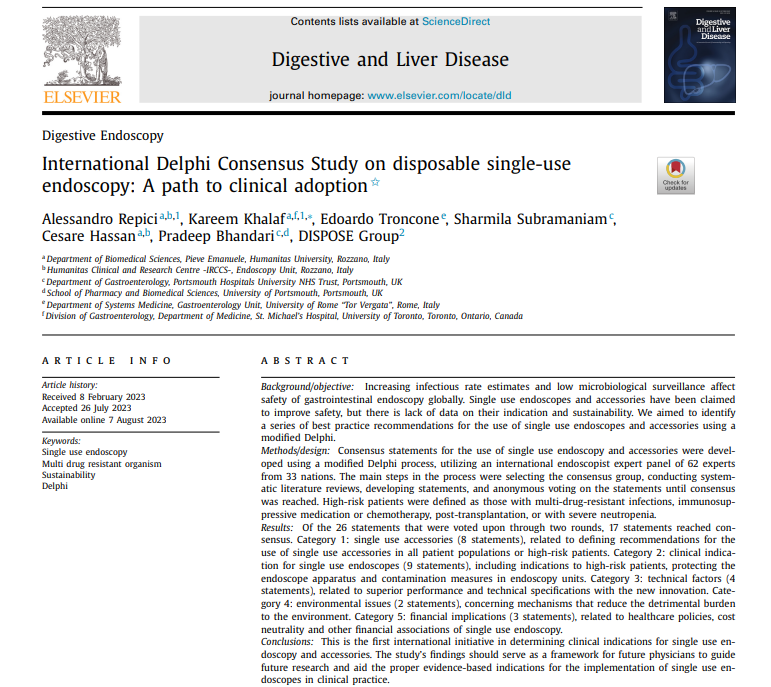
Clinical interpretation: For patients who are infected or colonized with MDROs, as well as those who are severely immunocompromised, single-use endoscopy has moved from being a backup option to a viable clinical choice.
Chinese Consensus: Emergency Infection Control During Infectious Disease Outbreaks
The Chinese Expert Consensus on the Diagnosis and Treatment of Digestive System Involvement in COVID-19 states that, for confirmed or suspected infected patients with an indication for endoscopy, single-use endoscopes may be selected where conditions allow to reduce contact with contaminants.[2]
2026 Group Standard: Standardizing Equipment Configuration in Clinical Departments
In the 2026 group standard, Standard for the Construction and Equipment Configuration of Gastrointestinal Endoscopy Centers, issued by the National Association of Health Industry and Enterprise Management, the single-use gastrointestinal endoscopy system is formally listed as medical equipment that may be flexibly configured according to actual diagnostic and therapeutic needs.[3]
The successive publication of these consensus statements and group standards has not only clarified core applications involving high-risk patients, elevated contamination risk, and time-critical emergency workflows, but has also provided direction for continued technological development and product iteration.[1–3]
The EndoFresh® Evidence Matrix
From Feasibility to Validation Across Multiple Clinical Settings
Consensus statements define the boundaries of appropriate use, but clinical adoption still requires a credible “report card.” For a medical device, clinical value cannot remain merely a design concept. When determining whether a gastrointestinal endoscope can enter real-world clinical practice, physicians focus on more specific questions:
Can the image quality support clinical visualization and decision-making? Are insertion and maneuverability stable? Can insufflation, irrigation, and suction support the complete examination workflow? Can the working channel accommodate the necessary instruments and procedures? In nonconventional settings such as emergency departments, bedside care, and intraoperative use, can the system keep pace with clinical workflows?
In response to these real-world clinical needs, the evidence base supporting EndoFresh® continues to grow:
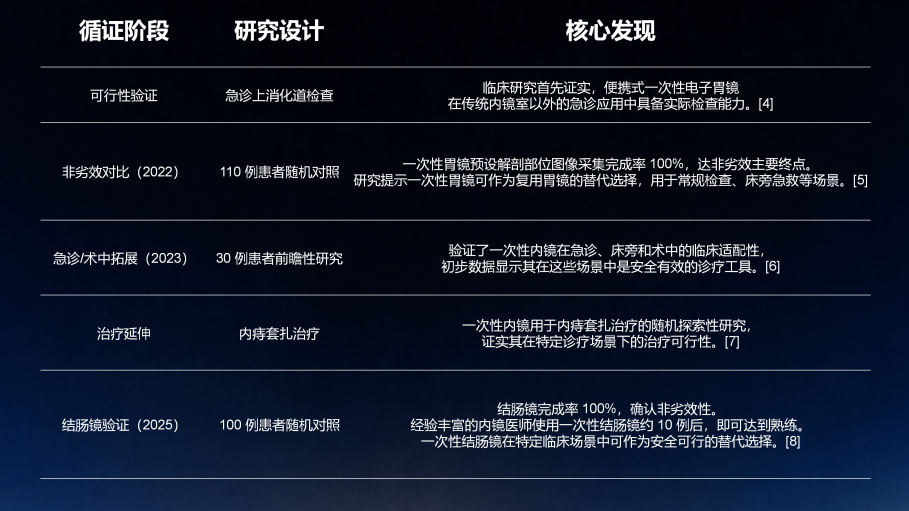
As of July 2026, 17 research publications related to EndoFresh® had been produced and published in professional Chinese and international journals, including the Medical Journal of Chinese People’s Liberation Army, Gastrointestinal Endoscopy, and Digestive Endoscopy.
Evidence-based medicine is not a collection of isolated data points. It is a chain of evidence driven by clinical needs and strengthened through high-quality research. Every expansion of the EndoFresh® application scope—from the upper gastrointestinal tract to therapeutic procedures and subsequently to the lower gastrointestinal tract—has been accompanied by rigorous evidence-based investigation. Ultimately, efficient equipment turnaround serves one essential purpose: to identify problems before the body sounds the alarm.
In the next article, we return to the starting point of clinical value: Who should undergo gastroscopy and colonoscopy?
References
[1] Repici A, Khalaf K, Troncone E, et al. International Delphi Consensus Study on disposable single-use endoscopy: A path to clinical adoption [J]. Digestive and Liver Disease, 2024, 56(2): 322–329.
[2] Chinese Society of Gastroenterology, Chinese Medical Association. Expert consensus on the diagnosis and treatment of digestive system involvement in COVID-19 [J]. National Medical Journal of China, 2020;100(16):1212–1216.
[3] National Association of Health Industry and Enterprise Management. T/NAHIEM 167—2026 Standard for the Construction and Equipment Configuration of Gastrointestinal Endoscopy Centers.
[4] Xu L, Sun G, Yang YS, Li Y, et al. Preliminary application of a portable single-use electronic gastroscope in emergency upper gastrointestinal examination [J]. Medical Journal of Chinese People’s Liberation Army, 2020;45(3):256–259.